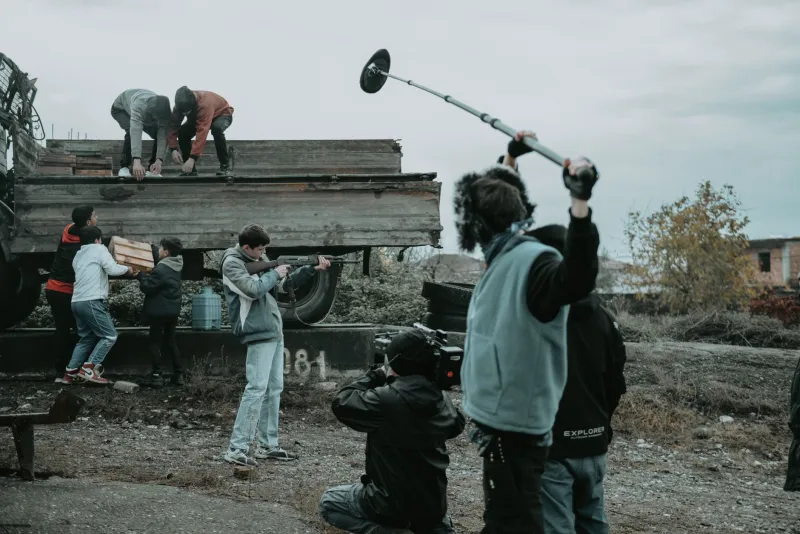
Stream or Be Streamed: Why Netflix, Amazon, and Apple Are Throwing Cash at Australian Talent
There's a bidding war happening, and for once, Australia is sitting at the head of the table.
Netflix, Amazon Prime Video, and Apple TV+ have all quietly — and sometimes not so quietly — been accelerating their push into the Australian talent market. Actors, directors, showrunners, writers. If you've got a credit on something that got people talking, there's a decent chance at least one streaming executive has slid into your agent's inbox. The question worth asking isn't whether this is happening. It's whether our talent is actually winning.
The Bidding War Nobody's Officially Talking About
Industry insiders have been whispering about it for a while now, but the past eighteen months have seen the volume turn up considerably. Multiple Australian production companies have confirmed — off the record, naturally — that first-look deals and exclusive development agreements are being offered at a pace that feels genuinely unprecedented.
The mechanics are straightforward enough. A streaming platform offers a creator or actor a financial arrangement that gives them first right of refusal on any new project that person develops. In exchange, the talent gets a financial cushion, institutional support, and the kind of global distribution that a local broadcaster simply cannot match. Sounds great on paper. And for some, it genuinely is.
But here's the catch: first-look deals can also function as a leash. Once you're locked into an arrangement with Netflix or Amazon, your creative output flows through their pipeline, their notes process, their algorithm-informed preferences. For Aussie storytellers who've spent careers building something distinctly local, that tension is very real.
Who's Actually Winning the Talent Chase
Let's talk names without naming names — because that's apparently how this industry works.
Several high-profile Australian actors who built their reputations in action and spy-adjacent genre work have recently signed what their representatives describe as "multi-project development arrangements" with at least two of the three major streamers. The pattern is consistent: an actor who's done a stint in a major Hollywood franchise, returned to Australian shores, and suddenly found themselves fielding calls from Los Angeles, London, and wherever Apple TV+ is headquartered this week.
On the directing side, the surge is even more pronounced. Australian directors who've cut their teeth on local action dramas — the kind of tightly plotted, character-driven thrillers that Australian television has been quietly perfecting for years — are being actively recruited. The streaming platforms have figured out something the Hollywood studio system was slower to grasp: Aussie directors know how to make tension work on a budget, and they bring a visual grammar that feels fresh to international audiences.
The Apple Factor
Of the three major players, Apple TV+ has arguably been the most aggressive in its Australian courtship, and the most selective. Where Netflix casts a wide net and Amazon tends to follow proven IP, Apple has shown a genuine appetite for original, high-concept material developed from scratch with Australian talent attached from the ground floor.
This matters for the action and spy thriller space specifically. Apple's investment in prestige genre content — think the kind of slow-burn espionage drama that rewards patient audiences — aligns almost perfectly with what Australian creators have been producing domestically for years without the global platform to match. The marriage of Apple's distribution muscle and Australian genre sensibility is, frankly, a pairing worth watching closely.
Power Shift, or Same Old Story?
Here's where the optimism needs a reality check.
For every Aussie talent who's negotiated a genuinely equitable streaming deal, there are others who've signed arrangements that look transformative on the surface but function, in practice, as a more sophisticated version of the old Hollywood poaching model. The talent leaves. The stories leave. The cultural fingerprints get smoothed out in post-production to suit a global audience that the algorithm has decided exists.
Local industry advocates have raised this concern repeatedly, and it's not an abstract one. When an Australian actor signs exclusively with a US-based streamer, they become — at least partially — unavailable to the local productions that helped build their profile in the first place. Screen Australia and various state-based funding bodies are navigating this tension constantly, trying to incentivise local production while acknowledging that their best talent now has options that simply didn't exist a decade ago.
The counterargument, and it's a fair one, is that Australian talent has always faced a binary choice: stay local and accept a ceiling, or go overseas and accept someone else's terms. If streaming platforms are at least bringing some of that negotiation back to Australian soil — if the meetings are happening in Sydney and Melbourne rather than only in Burbank — that's a structural shift worth acknowledging.
What This Means for the Spy and Action Space
For fans of the genre — and if you're reading Operation Oz, that's almost certainly you — the streaming arms race has a specific and exciting implication. The spy thriller and action drama formats are among the most actively developed categories across all three platforms. Amazon's success with Reacher and its various espionage properties, Netflix's continued investment in globe-trotting action content, Apple's prestige-level genre bets — all of it creates real demand for the kind of talent Australia has been quietly producing.
Aussie actors who've spent years playing second-tier operatives in American productions are now being looked at as leads. Directors who've been perfecting chase sequences and interrogation room tension on local budgets are suddenly attractive to platforms with eight-figure episode budgets. The genre is hungry, and Australian talent is well-positioned to feed it.
The Bottom Line
The streaming giants are absolutely fighting over Australian talent. That part isn't in dispute. What remains genuinely open is whether our creators and performers are negotiating from a position of strength, or whether the excitement of the moment is causing some of them to sign deals they'll reassess in three years.
The smart money — literally — is on the talent that holds out long enough to let the platforms bid against each other. Australia has spent decades producing world-class performers and storytellers who've had to accept second-best terms because the alternatives were limited. Those alternatives have multiplied dramatically. The leverage is real. Whether the industry is organised enough to use it collectively, rather than letting individuals get picked off one by one, is the question that actually matters.
For now, though, the fact that the conversation is happening on our terms — or at least on our timezone — feels like progress worth noting.